CCS2 to GB/T Adapter Buying Guide – 5 Critical Mistakes That Can Derail Your EV Charging Project
More Chinese-made electric vehicles are hitting European roads than ever before. BYD, Nio, Xpeng, Geely, and other brands are gaining traction across the continent. But there is a practical challenge that every owner and fleet operator eventually faces: how do you charge a GB/T vehicle at a European CCS2 charging station?
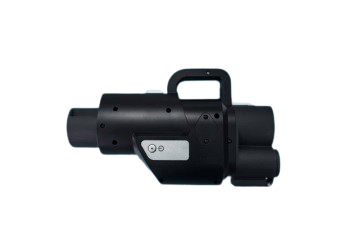
The answer lies in a CCS2 to GB/T DC adapter. But not all adapters are created equal—and choosing the wrong one can stop your charging project before it even begins . Here are five critical mistakes to avoid.
Mistake #1: Confusing AC and DC Adapters
This is the most common and potentially dangerous mistake. AC adapters and DC adapters are completely different products—they are not interchangeable.
For AC charging, the adapter connects a Type 2 AC plug (the upper section of a CCS2 connector) to a GB/T AC vehicle inlet. The vehicle’s onboard charger converts the AC power to DC. Typical AC adapters are rated for 16A, 32A, or 63A, with single-phase or three-phase operation .
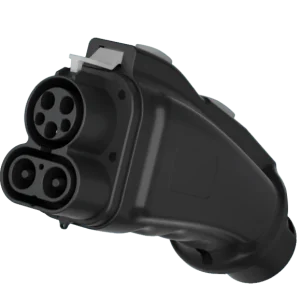
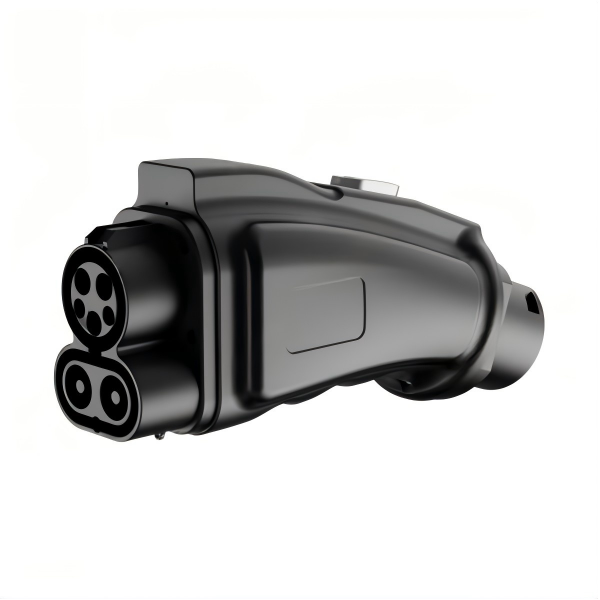
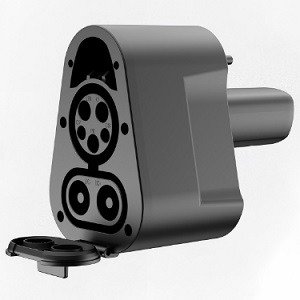
For DC fast charging, the adapter uses the full CCS2 Combo 2 connector, including the two additional DC pins. DC adapters require active protocol conversion because CCS2 stations communicate using PLC (Power Line Communication) under DIN 70121 and ISO 15118, while GB/T vehicles use CAN bus communication under GB/T 27930 . A simple “passive” adapter with copper contacts cannot perform this translation.
The takeaway: Before buying, confirm whether your application is AC or DC. Never assume one adapter can handle both.
Mistake #2: Buying a Passive Adapter for DC Charging
A low-cost passive adapter may look appealing, but for DC charging, it creates a serious compatibility and safety risk .
DC charging requires more than just physical connection. The charger must identify the vehicle, negotiate voltage and current limits, monitor faults, and safely stop charging. A connector alone cannot perform these functions .
A properly engineered DC adapter includes:
-
Active protocol conversion electronics that translate PLC to CAN signals
-
Contactor control to safely switch high-voltage DC
-
Temperature monitoring to prevent overheating
-
Insulation fault detection for safety
If the adapter does not actively manage these functions, charging may not start—or worse, could stop unsafely under load.
Mistake #3: Overlooking Power Rating vs. Real-World Performance
Specifications like “200A” or “400A” require careful interpretation. Rated current is not always continuous current.
At high DC currents, even small increases in contact resistance create substantial heat . An adapter labeled 250A may not support 250A continuously in every ambient temperature or at every voltage level .
Here is the real-world performance you can expect:
-
800V architecture vehicles can receive up to 320kW with a 400A/1000V adapter
-
400V architecture vehicles typically receive up to 160kW with the same adapter
The power limit is determined by the complete operating envelope, including cable design, terminal material, contact resistance, and cooling method . Always ask the supplier for performance data under real-world conditions, not just peak ratings.
Mistake #4: Ignoring Compatibility Testing and Firmware Support
Not every adapter works with every vehicle and charger combination. EV models and charger firmware do not always implement standards in exactly the same way .
A quality active adapter should be validated across relevant vehicle and charger combinations . Look for evidence that the adapter has been tested with vehicles like BYD, Nio, Xpeng, and VW ID series, and chargers from ABB, Siemens, Alpitronic, Tesla Supercharger, and others .
Equally important is firmware update capability. Charging networks and vehicles evolve. A built-in USB-C port for firmware updates and lifetime software support ensures your adapter remains compatible when new stations or vehicle updates are released .
Mistake #5: Neglecting Environmental and Safety Specifications
European climates vary dramatically—from Mediterranean heat to Nordic cold. Your adapter must handle it.
Key specifications to verify:
-
Operating temperature range: Look for –40°C to +85°C for year-round reliability
-
IP rating: IP54 or higher for weather protection
-
Certification: CE certification confirms compliance with EU safety standards
Pro tip: For commercial or fleet projects, ask how the adapter responds when a charging session is interrupted. The adapter should predictably handle loss of communication and emergency stop conditions .
Checklist: Four Questions Every Buyer Must Ask
Before purchasing a CCS2 to GB/T adapter, ask the supplier:
-
Is this an AC or DC adapter? Confirm it matches your charging application.
-
Does it have active protocol conversion? Passive adapters are unsafe for DC.
-
What vehicle and charger combinations have been tested? Check compatibility with your specific models.
-
How are firmware updates handled? Future compatibility depends on software support.
Why This Matters for Your EV Journey
With the right CCS2 to GB/T adapter, GB/T vehicles can charge seamlessly on Europe’s extensive CCS2 network. But the wrong choice can lead to failed charging sessions, equipment damage, or safety risks.
Take the time to verify your application, check specifications carefully, and choose a product with active protocol conversion and firmware update support. Your charging experience depends on it.
Looking for a reliable CCS2 to GB/T adapter for your vehicle? Browse our [product] for high-performance DC fast-charging adapters with lifetime firmware support.
DC-768x768.png)